How AI Is Improving Pet Health Monitoring
Last updated
PetTech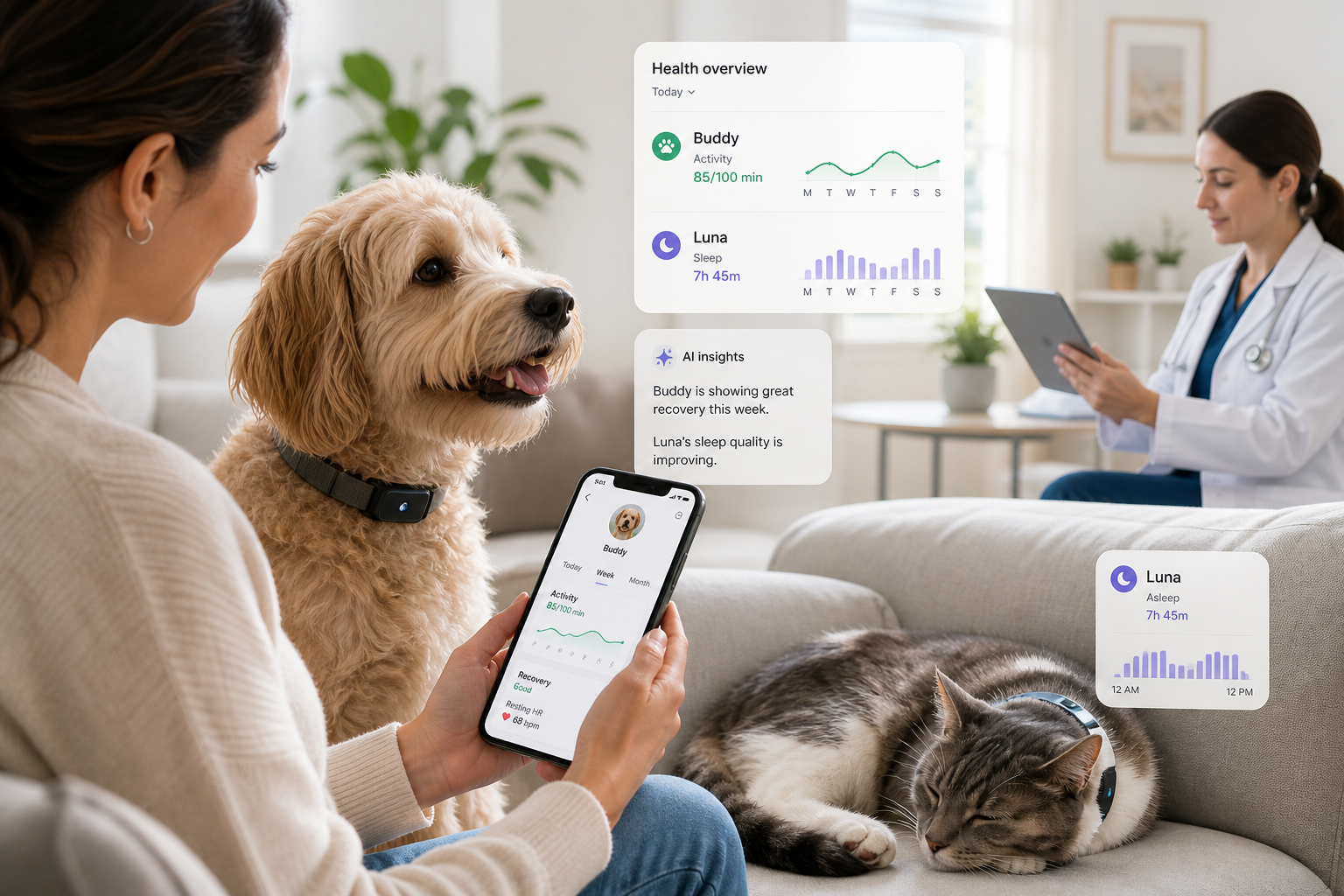
How AI Is Improving Pet Health Monitoring
AI is changing pet health monitoring by making it easier to spot patterns that owners and veterinarians might otherwise miss. Instead of relying only on occasional checkups or memory, newer tools can track activity, sleep, behavior, eating patterns, heart rate, respiratory signals, and sometimes even subtle changes in movement or sound. That matters because many health problems start quietly. By the time a pet looks obviously unwell, the pattern may already have been building for days or weeks.
One of the biggest improvements is that AI can turn raw data into something understandable. A wearable sensor may collect hundreds of signals, but the real value comes when software turns those signals into a trend, an alert, or a simple summary. The NIH’s work on wearable sensors shows why this matters: continuous monitoring can help detect changes in vital signs or activity that may signal illness earlier than a person would notice on their own. In pet care, that same logic is being applied to dogs and cats through collars, cameras, mobile apps, and AI models that look for changes over time.
AI is especially useful because pets cannot explain how they feel. A dog cannot say it is sleeping poorly, recovering slowly, or moving less because of pain. A cat cannot tell you that small changes in appetite or grooming are becoming important. AI tools can help fill that gap by making patterns visible. They do not replace a veterinarian, but they can make the conversation with one much more informed.
A major example is wearable monitoring. Research on companion animals published in the 2026 systematic review The Expanding Role of Artificial Intelligence in Companion Animal Care found that AI is increasingly being used for diagnosis, behavior analysis, and early welfare monitoring, especially when paired with sensor data. The review also notes that wearable sensors and video analysis are promising for continuous monitoring, even though validation and data quality remain important challenges. In other words, AI is helping because it can watch patterns continuously, not just during a brief appointment.
AI is also improving pet health monitoring through image-based tools. Mars launched GREENIES Canine Dental Checkin 2025 as an AI-powered tool that helps pet parents monitor canine dental health from a smartphone photo. That kind of tool is useful because dental disease is often hidden until it is advanced. If an app can help owners notice plaque buildup or oral changes earlier, that can support better preventive care. It does not diagnose a full dental exam, but it can encourage earlier action.
Another important area is behavior monitoring. AI is increasingly being used to analyze movement, rest, vocalization, and even video-based behavior changes. A 2026 study in Frontiers showed that AI vision models could track canine activity, behavior, and clinical observations from video with strong correlation to accelerometer-based data. Frontiers study on canine monitoring That matters for both home and research settings because it makes it possible to detect changes like limping, anxiety, stiffness, or reduced activity more objectively.
For pet owners, the biggest benefit is early awareness. A wearable or AI app can show that a pet is moving less, sleeping differently, scratching more, or recovering more slowly after exercise. A single unusual day may not mean much. But a change in the trend can be a useful warning sign. That is where AI is most valuable: not in replacing medical judgment, but in helping people notice what has changed sooner.
AI is also becoming useful in veterinary diagnostics. A 2026 PubMed study on automated detection of canine heart murmurs found that a deep learning model trained on digital stethoscope data achieved performance comparable to experienced veterinarians. That kind of work matters because it shows AI can support screening in a way that is more consistent and less dependent on one person’s interpretation. Again, it is not a replacement for clinical care, but it can make screening faster and more objective.
The larger shift is that pet health monitoring is becoming more continuous and less reactive. Instead of waiting until something seems wrong, AI helps owners and vets look at signals over time. That can make preventive care easier, especially when the data is collected passively in the background. The result is less guesswork, better trend tracking, and earlier conversations about what a pet may need.
Still, the technology has limits. AI is only as good as the data it receives, and not every device or app is equally accurate. Fit, environment, behavior, and model quality all matter. A pet monitor can be helpful, but it should never be treated as final proof that a pet is healthy or sick. The safest use is as a support layer: AI helps flag patterns, while the veterinarian decides what those patterns mean.
The bottom line is that AI is improving pet health monitoring by making it more continuous, more personalized, and easier to understand. It is helping owners see changes earlier, helping veterinarians work with better data, and making preventive care more practical. That is a meaningful shift. The future of pet health is not just more data. It is better awareness.